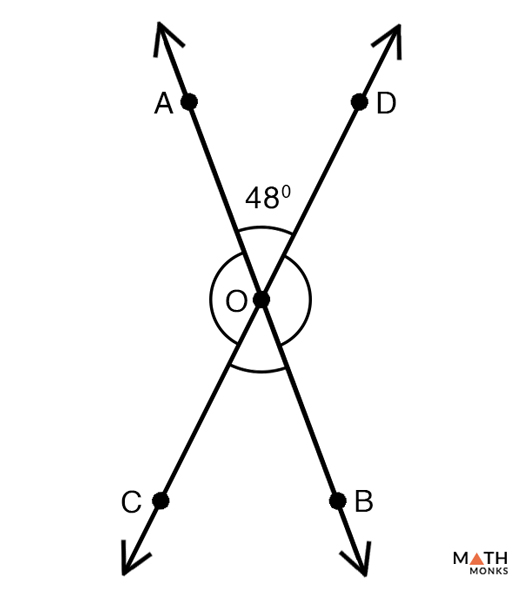
Vertical Angles Are Always. Two angles are said to be supplementary when the sum of the two angles is 180°. It should be noted that two vertical angles are always equal.
Vertical Angles Definition, Theorem with Examples from mathmonks.com
When two straight lines intersect you get four angles. Vertical angles are always, by definition, congruent. Why vertical angles are always congruent?
Two Angles Are Vertical Angles, If Their Sides Form Two Pairs Of Opposite Rays.
The opposite pair of angles after the intersection of two straight lines are known as vertically opposite angles. Vertical angles are the angles opposite each other when two lines cross. Vertical angles are also called opposite angles.
In The Picture Angles A And B Form One Pair Of Vertical Angles.
Complementary/supplementary angles are always adjacent, with complementary angles totalling 90° and forming a right angle, and supplementary angles totalling 180° and forming a straight line. In other words, whenever two lines cross or intersect each other, 4 angles are formed. Adjacent angles are angles that come out of the same vertex.
Why Vertical Angles Are Always Congruent?
In mathematics, two straight lines intersect a point (vertex) to form angles. The red angles ∠jqm and ∠lqk are equal,as are the blue angles ∠jql and ∠mqk. Vertical angles are always congruent (have the same measure).
I'm Not Sure Of The Textbook Definition, But A Pair Of Angles That Share A Vertex, And Where Each Ray Of One Angle Falls In The Same Line With Exactly One Ray Of The Other Angle Would Be A Pair Of Vertical Angles.
Vertical angles are defined as the angles opposite to each other when two lines cross (i.e. It is also known as vertically opposite angles. Definition of vertical angles more.
Also, A Vertical Angle And Its Adjacent Angle Are Supplementary Angles, I.e., They Add Up To 180 Degrees.
Adjacent angles share a common ray and do not overlap. 3 rows vertical angles are always congruent. The angles opposite each other when two lines cross.