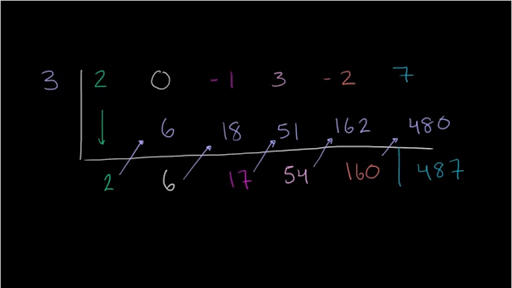
Khan Academy Rational Zero Theorem. Khan academy | práctica, lecciones y cursos en línea gratuitos. Minus 200, we do it in that green color, minus 297.
How To Factor Polynomials With 4 Terms Synthetic Division from howtobook88.blogspot.com
+ a 2x 2 + a 1x + a 0 are integers with a n ≠ 0 and a 0 ≠ 0. Equivalently, the theorem gives all possible rational roots of a polynomial equation. If a polynomial function, written in descending order of the exponents, has integer coefficients, then any rational zero must be of the form ± p / q, where p is a factor of the constant term and q is a factor of the leading coefficient.
+ A 2X 2 + A 1X + A 0 Are Integers With A N ≠ 0 And A 0 ≠ 0.
So the remainder, if i were to divide this by this, is equal to zero. The rational zero theorem the rational zero theorem gives a list of possible rational zeros of a polynomial function. Multiplicities are counting a repeated root as more than.
The Rational Zeros Theorem Lists All Possible Rational Numbers That Could Be Potential Candiates For Zeros.
Use the prt (polynomial remainder theorem) to determine the factors of polynomials and their remainders when divided by linear expressions. Let me do that k in that purple color, 4 choose k of a to the 4 minus k power, 4 minus k power times b to the k power, b to the k power. The rational zero theorem helps us to narrow down the number of possible rational zeros using the ratio of the factors of the constant term and factors of the leading coefficient of the polynomial consider a quadratic function with two zeros, \.
Not Every Number In The List Will Be A Zero Of The Function, But Every Rational Zero Of The Polynomial Function Will Appear Somewhere In The List.
Descarte's rule of signs helps in determining the different possibilities for positive and negative real zeros. Apply rational zero theorem to find possible rational zero candidates. Para cada estudiante, cada salón de clases.
Consider A Quadratic Function With Two Zeros, And By The Factor Theorem, These Zeros Have Factors Associated With Them.
The rational zeros theorem helps us find the rational zeros of a polynomial function. And then we have, i'm prone to make careless errors here, see 90 plus 45 is 135. If a polynomial function, written in descending order of the exponents, has integer coefficients, then any rational zero must be of the form ± p / q, where p is a factor of the constant term and q is a factor of the leading coefficient.
The Rational Zero Theorem Helps Us To Narrow Down The Number Of Possible Rational Zeros Using The Ratio Of The Factors Of The Constant Term And Factors Of The Leading Coefficient Of The Polynomial.
If the quotient is not qaudratic, the process is find a zero is repeated. Use various methods in order to find all the zeros of polynomial expressions or functions. Use synthetic division to find identify such a zero and find the quotient.