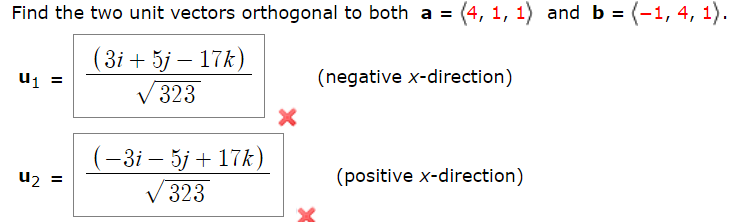
Find A Vector Orthogonal To Both U And V. For example, a = 1, b = 1, c = − 1 works. Use the cross product to find a vector that is orthogonal to both u and v.
Answered Find the two unit vectors orthogonal to… bartleby from www.bartleby.com
About press copyright contact us creators advertise developers terms privacy policy & safety how youtube works test new features press copyright contact us creators. Type the coordinates of the vectors; X = ( a, b, c) x= (a,b,c) x = ( a, b, c) such that:
Now The Cross Product Of These Two Victors.
If you mean that w= u x v, then, as njama said, you want to look at the dot product of w with u and v, not the cross product. Where did w come from? The cross product is orthogonal to both.
Use The Cross Product To Find A Vector That Is Orthogonal To Both U And V.
There are many possible solutions for a, b, c which satisfy both of these equations. Interpreting this as finding unit vectors orthogonal to v, and separately for u: Therefore, taking → u × → v = → w, say, we get, → w = ∣∣ ∣.
Is A Vector That Is ⊥ To Both → X &→ Y.
0 votes use the given vectors u, and v to find the expression. Find a unit vector that is orthogonal to both u and v. Read it talk to a tutor submit answer practice another version 7.
Find The Value Of S So That V+Sw Is Perpendicular To W.
Now the question, it is said that we need to use the cross product to find an orthogonal victor. X = ( a, b, c) x= (a,b,c) x = ( a, b, c) such that: Modified 6 days ago by krishna_agrawal ♣ 2.1k.
Asked Jan 31, 2015 In Precalculus By Anonymous.
That is a + c = 0 and b + c = 0. Type the coordinates of the vectors; ( 101,212 points) asked in mathematics 29 minutes ago 2 views.