What If The Discriminant Is Negative. A negative discriminant indicates that neither of the solutions are real numbers. Then, what if the discriminant is less than zero?
Si el discriminante de una ecuación cuadrática es 5, ¿qué from elbuhosabio.info
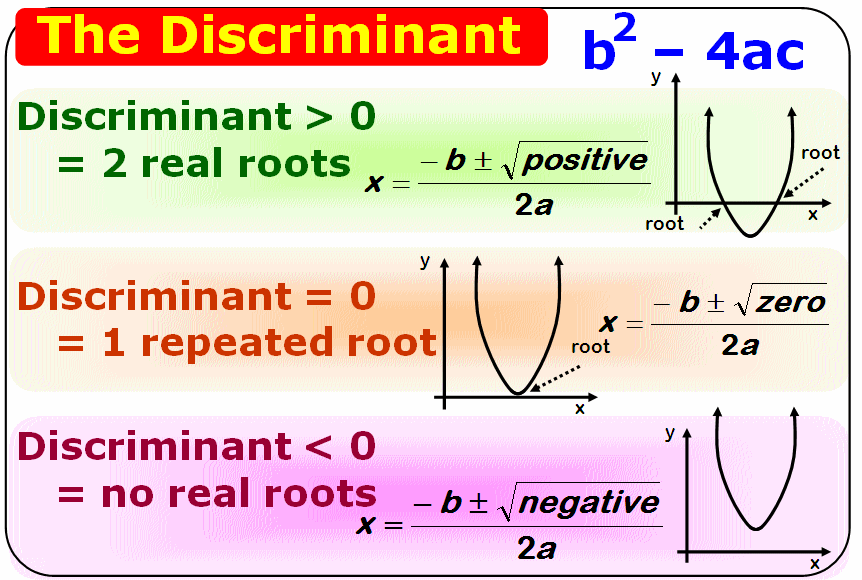
The discriminant shows you the type and number of solutions of the graph. If the discriminant is positive, then you have , which leads to two real number answers. A negative discriminant indicates that neither of the solutions are real numbers.
If The Discriminant Is Negative, That Means There Is A Negative Number Under The Square Root In The Quadratic Formula.
A discriminant of zero indicates that the quadratic has a repeated real number solution. A negative discriminant denotes that neither of the solutions is real numbers. You may have learned in the past that you can't take the square root of a negative number. the truth is that you can take the square root of a negative number
If The Discriminant Is Positive, Then You Have , Which Leads To Two Real Number Answers.
If the discriminant is negative, that means there is a negative number under the square root in the quadratic formula. If it's negative, you have , which gives two complex results. Since there will be no roots, the polynomial cannot be equal to zero for any real number.
Now, The Zeros Or Roots Of The Quadratic Equation Can Be Written In The Following Form.
When discriminant is zero, it shows that there are repeated real number solution to the quadratic; A negative discriminant if the discriminant is negative, that means there is a negative number under the square root in the quadratic formula. This means that if you have a negative discriminant, you will get two complex solutions.
If The Solutions Are Both Complex, You Will Not See Them On The Graph.
What is the discriminant and how many solutions would this quadratic have? How does the discriminant work? The discriminant shows you the type and number of solutions of the graph.
You May Have Learned In The Past That You “Can’t Take The Square Root Of A Negative Number.” The Truth Is That You Can Take The Square Root Of A Negative Number, But The Answer Is Not Real.
A negative discriminant indicates that neither of the solutions are real numbers. A discriminant of zero indicates that the quadratic has a repeated real number solution. What is true is that if the discriminant is negative then there will be no real roots of the equation.